
Indian benchmark indices, Sensex and Nifty, rallied significantly following a sharp decline in crude oil prices. This decline was triggered by US President Donald Trump's announcement of progress in negotiations with Iran towards a peace agreement, which led to renewed optimism in global markets.
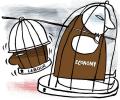
The new labour Codes, notified by the central government in November 2025, have pushed up employee costs for private-sector banks and insurance companies, with these firms reporting higher operating expenses in the October-December quarter (Q3FY26) due to the statutory impact of the new labour Codes.
HDFC Bank has reshuffled the portfolios of its senior management team. This is the first major rejig after the amalgamation of HDFC Ltd on July 1. "The runway for our growth is large. This change is being done to bring in a very sharp focus on leveraging what we have built and for enhanced execution," said Sashidhar Jagdishan, managing director and chief executive of HDFC Bank, explaining the reason for this overhaul.

IndusInd Bank was the biggest gainer in the Sensex pack, rising 3.25 per cent, followed by Tech Mahindra, Wipro, Bharti Airtel, HCL Technologies, Axis Bank, HDFC Bank, RIL, TCS, L&T and Infosys. State Bank of India, NTPC, Maruti, Bajaj Finserv, Tata Motors and Power Grid were among the laggards, slipping up to 2.94 per cent.

Indian equity markets, including the Sensex and Nifty, experienced a significant downturn for the second consecutive day, driven by escalating geopolitical tensions in West Asia and persistent foreign fund outflows.

The country's two largest private sector banks ICICI Bank and HDFC Bank on Wednesday revised interest rates on fixed deposits by up to 0.50 per cent each, a week after State Bank of India reduced term deposits rates.

HDFC Bank, India's second-largest private bank, has overtaken ICICI Bank, the largest private player, in terms of market capitalisation to top the rankings among private banks.

Sensex gains over 400 points while Nifty trades above 23,800 amid strong IT sector buying.

From the 30-Sensex firms, Tata Steel, Asian Paints, Trent, State Bank of India, Hindustan Unilever, UltraTech Cement, ICICI Bank and Bharti Airtel were among the gainers. On the other hand, Infosys, Bajaj Finance, Bharat Electronics, Larsen & Toubro and HDFC Bank were the laggards.
State Bank of India has entered into an alliance with HDFC Bank for sharing ATM networks to be operationalised from February 3 this year.
Close to 9,000 start-ups are currently banking with HDFC Bank and it has the bank now dedicated SmartUp zones in 70 branches in 30 cities across India.
Shortly after the Reserve Bank of India cut its signaling rates and the announcement of stimulus package, leading lenders HDFC Bank and Union Bank of India on Monday reduced their benchmark prime lending rates (PLR).

The Reserve Bank of India (RBI) is set to revise its directives for bank boards, aiming to alleviate operational burdens and enable them to concentrate on crucial policy and strategic decision-making, thereby enhancing corporate governance in the Indian banking sector.
HDFC Bank has ensured that no bank will be able to match them in the near future without bleeding on margins.
Indian stock market benchmarks Sensex and Nifty rebounded by over 1% on Monday, driven by value-buying in banking stocks after a three-day slump. Key gainers included UltraTech Cement, HDFC Bank, and Mahindra & Mahindra.

Among the Sensex firms, State Bank of India, Maruti Suzuki India, Axis Bank, NTPC, BEL, Adani Ports, Eternal, Sun Pharmaceuticals, Power Grid, ITC, UltraTech Cement, Trent, HCL Technologies, Mahindra & Mahindra, and HDFC Bank were the major gainers. On the other hand, Tata Steel, Tata Consultancy Services, Tech Mahindra, Titan, Bajaj Finserv, Tata Motors, Bharti Airtel and Bajaj Finance were among the laggards.
More people are now comfortable using their debit cards.

HDFC Bank Q4 net rises 21% to Rs 2,806.91 crore.

From the Sensex firms, Eternal, NTPC, Kotak Mahindra Bank, ICICI Bank, Bajaj Finserv, Power Grid, Trent and HDFC Bank were among the major laggards. However, Bharat Electronics, Larsen & Toubro, Tata Consultancy Services, ITC and State Bank of India were the gainers.
From the 30-share pack, Titan, Tech Mahindra, Maruti Suzuki India, Wipro, Nestle India, TCS, Larsen & Toubro, HCL Technologies, Tata Steel and HDFC Bank were among the major laggards. NSE Nifty declined 69.75 points to settle at 17,153.

Companies listed on the National Stock Exchange (NSE) main board increased their Corporate Social Responsibility (CSR) expenditure by 23 per cent year-on-year to Rs 22,212 crore in 2024-25 (FY25), driven by a significant jump in average net profits, according to a PRIME Database Group report.
While HDFC Bank has vowed to recoup its lost market share in the credit card segment in three to four quarters by aggressively sourcing new cards, brokerages believe it is a little hard to come by, given how competitive the landscape has become, with other players in the market becoming equally aggressive to gain market share. Kotak Institutional Equities in its report on Monday said, "We would like to believe that the recovery in market share is likely to be gradual, if any. "All the key players, including Axis Bank, are now willing to expand their credit card portfolios as they have tested quite well against Covid-19."

Indian equity benchmark indices Sensex and Nifty tumbled over 1 per cent for the third consecutive day, driven by a sharp rally in crude oil prices, massive selling in IT stocks, and unabated foreign fund outflows amid ongoing geopolitical tensions in the Middle East.
Net profit rose to Rs 1,982 crore (Rs 19.82 billion) in the quarter ended September 30 from about Rs 1,560 crore (Rs 15.6 billion) a year earlier, the bank said on Tuesday. Net interest income grew nearly 15% to Rs 4,480 crore (Rs 44.8 billion).

Stock market benchmarks ended with losses for the third straight session on Wednesday as heightened geopolitical tensions, weak global peers and persistent foreign fund outflows unnerved investors.

The pickup was driven partly by fresh corporate investment but more by higher working-capital demand.

'He's at best a holding-CEO. Not one who will re-imagine the bank,' a senior banker and former colleague tells Raghu Mohan about HDFC Bank CEO & MD Sashidhar Jagdishan.
Benchmark equity indices Sensex and Nifty extended their gains for the second straight session on Monday, driven by optimism over the India-US trade deal and robust buying in public sector banks, consumer durables, and realty stocks.

Private sector banks slipped in market capitalisation (mcap) during the July-September quarter, underperforming their government-owned peers as trade uncertainties dragged market sentiment, said S&P Global Market Intelligence. According to its analysis, HDFC Bank shed 4.8 per cent in mcap during the third quarter, while ICICI Bank's dropped 6.7 per cent.

Sectoral funds, focused exclusively on public sector banks (PSBs), have delivered the strongest returns among domestic mutual fund (MF) categories over the past six months. However, active banking funds have significantly lagged because of their heavy tilt towards private lenders.

Banks and NBFCs are launching festival offers, including lower loan rates, cashback, EMI schemes and GST-linked benefits to tap rising demand ahead of Diwali
HDFC Bank has hiked its benchmark prime lending rate (BPLR) by 0.25 per cent to 15.25 per cent with immediate effect.

Indian benchmark indices Sensex and Nifty experienced volatility due to conflicting developments in West Asia, including reports of the Strait of Hormuz closure, which led to a rebound in crude oil prices and heightened investor concerns about supply disruptions and inflation.

Indian stock market benchmark indices Sensex and Nifty experienced a significant decline, driven by escalating tensions in the Middle East and rising crude oil prices.
Indian stock markets recovered from early losses to close higher, driven by value buying in IT and banking shares and a rebound in the rupee.
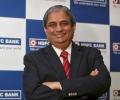
Tamal Bandyopadhyay details HDFC Bank's digital journey.
Benchmark equity indices Sensex and Nifty rebounded on Thursday after three sessions of losses, tracking gains in global markets after US President Donald Trump struck a conciliatory tone on Greenland. In a volatile session, the 30-share BSE Sensex climbed 397.74 points, or 0.49 per cent, to close at 82,307.37.

'The government's decision to keep interest rates unchanged on small savings schemes will certainly constrain banks' ability to cut deposit rates further.'
 © 2026 Rediff.com - Advertise with us - Disclaimer - Privacy Policy - Sitemap - Feedback - About us - Terms of use - Grievances